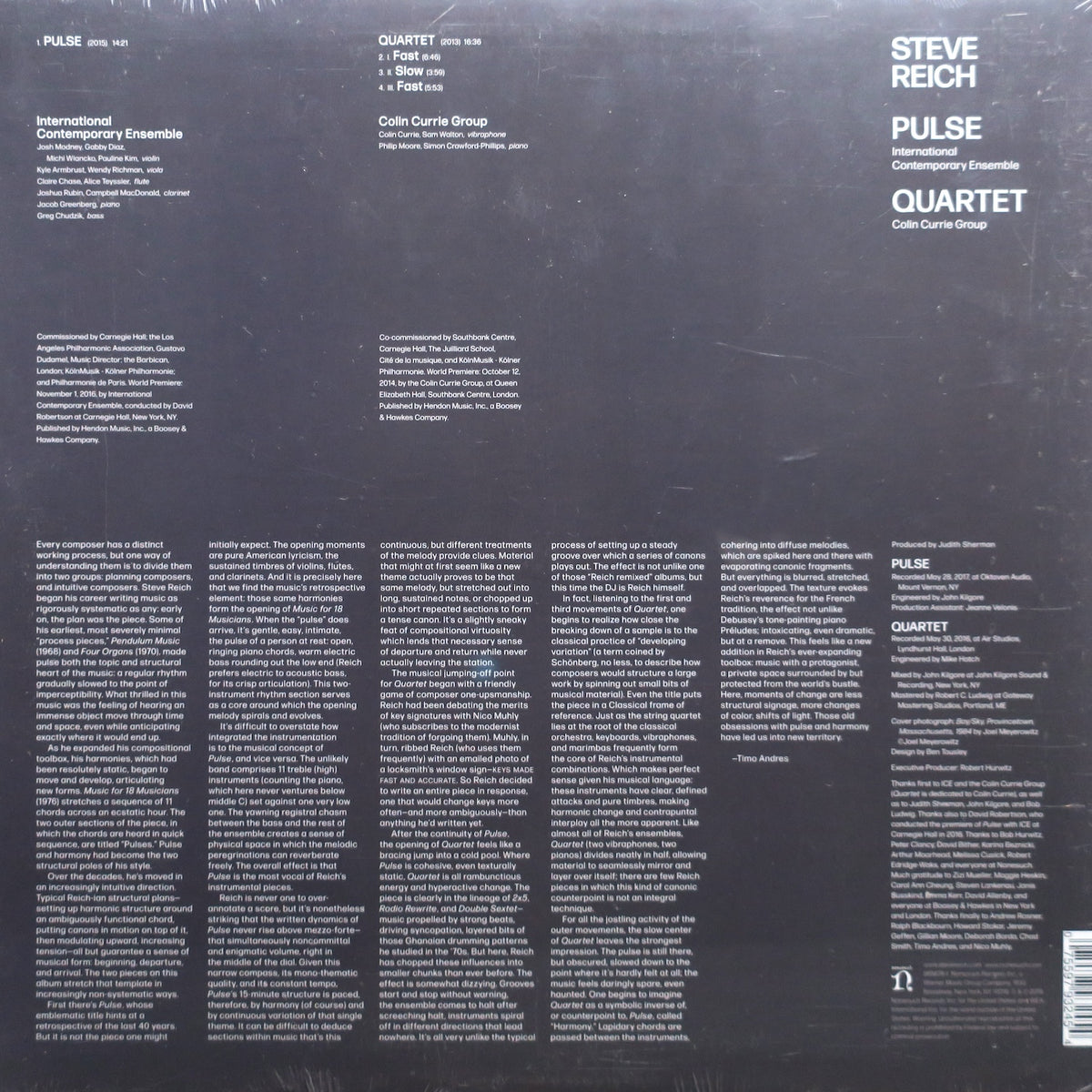
Steve Reich
Few composers of the late 20th century changed how listeners perceive pulse and repetition the way Steve Reich did. His early tape-piece "It's Gonna Rain" and subsequent phasing experiments turned microscopic timing shifts into musical drama: a looped pattern slowly slipping out of sync becomes form, texture and emotion rather than merely a gimmick.
Reich's voice grew from those analog experiments into works for live musicians that still sound modern. Drumming and Music for 18 Musicians show how strict rhythmic cells, reiteration and subtle shifts in harmony can create a sense of propulsion and ritual. Different Trains folded recorded speech and train sounds into a string quartet, marrying documentary impulse with Reich's obsession with pattern — the result is an emotionally direct piece that opened new possibilities for classical composition and multimedia storytelling.
Training and context matter. Reich arrived in a milieu that included La Monte Young and Terry Riley, whose early minimalism offered models of repetition, and the experimental legacy of John Cage, whose questions about process and sound Reich both absorbed and reacted against. Reich's approach, though, emphasized tight rhythmic control and gradual harmonic processes rather than indeterminacy; that distinction explains why his music has appealed both to classical audiences and to musicians in rock and electronic scenes.
Collaborations shaped several landmark recordings. The Kronos Quartet commissioned and premiered Different Trains, becoming the definitive interpreter of Reich's string works. Visual artist Beryl Korot partnered with Reich on video-operas such as The Cave, helping turn Reich's rhythmic structures into theatrical, multimedia statements.
Reich's influence runs widely: composers like John Adams grew from the same American post-minimalist thread, and electronic producers from Brian Eno onward have acknowledged how Reich's phasing and repetition reshaped ideas about texture and time. For a first deep listen, start with Music for 18 Musicians, then hear Drumming and Different Trains to understand how a single method — repetition with change — can yield a vast emotional and sonic range.
Reich remains a compelling presence because his pieces continue to reward close listening: patterns that seem simple on first hearing reveal complex internal motion the more they are played, making his music endlessly discoverable.
Recommended Artists: Philip Glass, Terry Riley, La Monte Young, Brian Eno